The TableSection 2
Pot, Swan Neck, Condenser
The distillery above Chapel Hill's brewpub runs on equipment whose geometry has not changed since the eighteenth century — and grain grown inside the state.
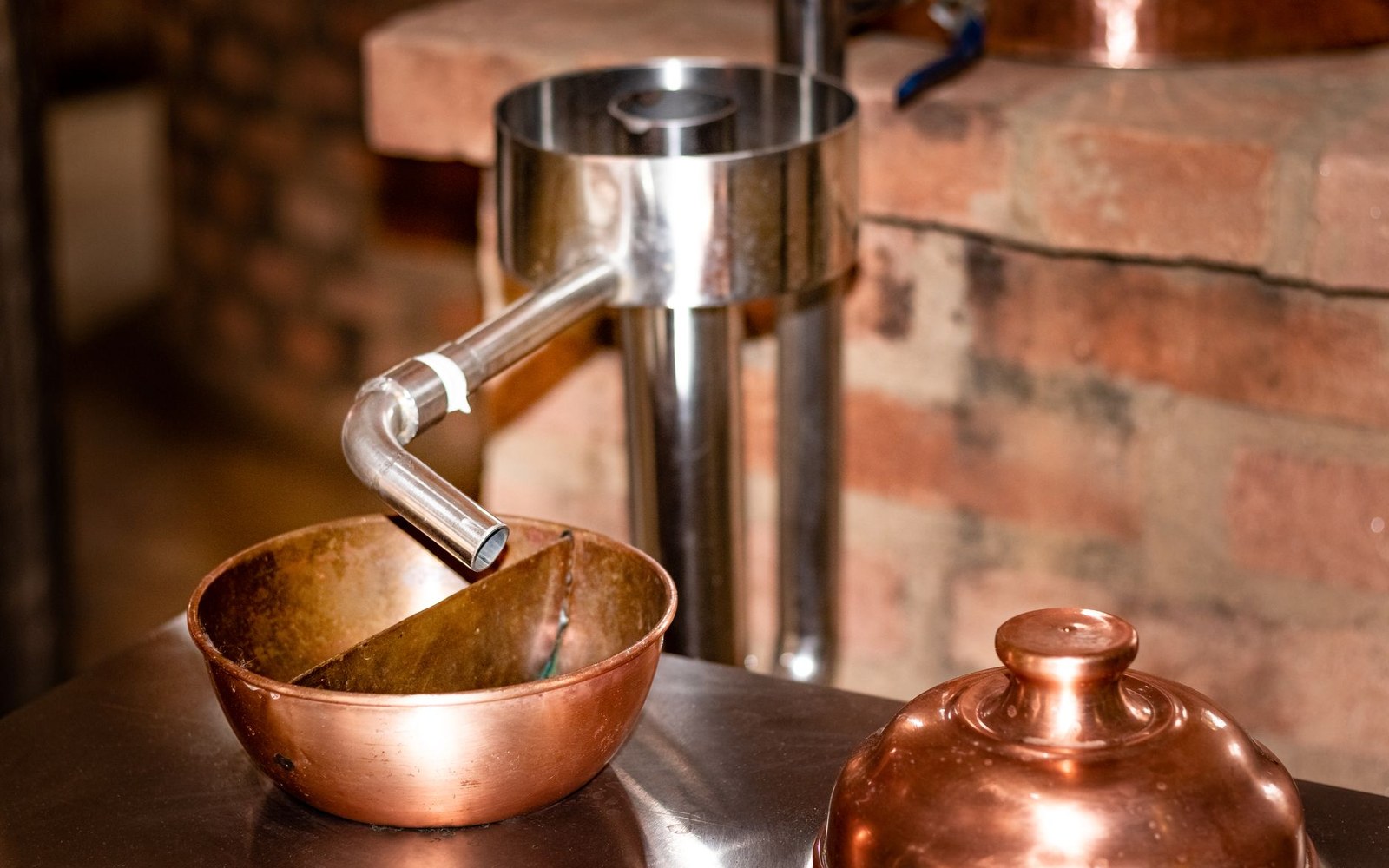
From Brewery to Distillery, One Floor Up
Top of the Hill Restaurant opened its brewpub operation on Franklin Street in 1996. Sixteen years later, in 2012, the same building acquired a second license and a second production identity: TOPO Distillery — short for Top of the Hill — began distilling spirits on the premises, making it one of the earlier craft distilleries to come online in North Carolina after the state revised its distillery laws to allow on-site sales and tastings. The brewery and the distillery share a building but operate as distinct production systems. One ferments and conditions beer; the other distills grain into vodka, gin, whiskey, and amaro. The equipment that makes the second operation work is old in its principles and specific in its mechanics.
What a Pot Still Actually Does
The central piece of equipment is the pot still, a type of distillation vessel in which a single batch of fermented liquid — the wash — is loaded into a sealed copper or steel pot and heated from below. As the liquid warms, alcohol vapour rises before water does, because alcohol has a lower boiling point. That vapour climbs upward through the swan neck, the curved pipe that arcs from the top of the pot toward the condenser. The angle and length of the swan neck matter: a taller, narrower neck forces heavier compounds to fall back into the pot before they can pass through, yielding a lighter, more refined spirit. A shorter, wider neck lets more congeners — the aromatic compounds that give character and weight — pass into the final product. TOPO's stills are designed for a spirit profile that suits the grain character of its North Carolina source material.
At the condenser, the vapour meets a cooled coil or tube — cold water circulates around it — and converts back into liquid. What comes off the condenser is not yet finished spirit. The distiller divides the run into three fractions: the foreshots, which come first and carry methanol and harsh volatiles; the hearts, which are the usable middle portion; and the tails, which trail off with heavier, oilier compounds. Only the hearts go forward. This cut is made by smell, taste, and measurement of alcohol concentration, and it is one of the most consequential decisions a distiller makes on any given run. Pot still distillation requires this cut to be made batch by batch, because the still does not operate continuously — when one run is finished, the pot is emptied, cleaned, and reloaded. The geometry of the vessel, the swan neck, and the condenser coil is the same in its essentials as the equipment used in Scottish and Irish distilleries two centuries ago.
North Carolina Grain, Named and Sourced
What distinguishes TOPO's operation as a regional production story is its grain sourcing. The distillery has sourced wheat and other grains from North Carolina farms, maintaining a commitment to in-state agricultural supply that reflects both a marketing position and a genuine supply-chain decision. North Carolina's agricultural interior — the Piedmont and coastal plain — produces soft red winter wheat suited to the state's climate. Using it in a grain spirit means the provenance claim extends beyond the still to the field.
That sourcing choice connects to a broader pattern visible across the Triangle food economy: the same logic that drives the Carrboro Farmers Market toward named-farm produce drives a craft distillery toward named-farm grain. The distance between the field and the still is a design decision, not just a talking point. When the grain is milled and mashed on premises, and the wash is distilled in a pot still on Franklin Street, the product is traceable in a way that a rectified spirit — one purchased as neutral grain alcohol and redistilled or simply flavored elsewhere — is not.
TOPO produces a range of spirits under its own label, including a vodka distilled from that North Carolina wheat, a gin built on the same base with botanical additions, and aged whiskey that requires time in barrel before it can legally carry the designation. The distillery operates within the same footprint that houses the brewery below it, on a corner of Franklin Street that has hosted both grain fermentation and grain distillation since 2012 — a building that now runs two parallel processes, separated by a floor, connected by the same raw material.